Complex work environments



Our
services

Working on buildings without disturbance
In civil engineering, this refers to office buildings, healthcare facilities, schools, and other non-residential functions. These buildings regularly require maintenance, cleaning, or facade modifications. With rope access, our specialists carry out these tasks without the need for cranes, facade elevators, or aerial work platforms. This means less disruption for users and the environment, and a shorter turnaround time.
Our IRATA-certified specialists are accustomed to working at height in urban environments. Whether it's an office building in the city center or a healthcare facility on the outskirts of town, we adapt our approach to the location and the client's requirements.
From window cleaning to sun protection
SkyPeople performs a variety of activities within the utility construction industry. Whether it's cleaning facades and windows, installing sunshades, or carrying out insulation work, our specialists work safely and efficiently at heights. Thanks to rope access, we can also reach the most difficult-to-access parts of a building without interrupting daily operations.
In addition to regular maintenance, we also carry out specialized tasks, such as fixing leaks, installing facade elements, or performing repair work on a building's outer shell. All with minimal disruption to the building's occupants.


One ticket for the entire journey
SkyPeople works for property owners, homeowners' associations, contractors, and facility managers. We think ahead about the best approach, draw up an action plan, and ensure smooth execution. This way, you have one point of contact for the entire project, from initial site survey to completion. Every project begins with a site survey.
Based on this, we draw up a Task Risk Analysis and determine the most suitable access method. This way, you know exactly what to expect in advance and the execution proceeds without surprises.
Projects in
hard-to-reach places


What our
clients say

“It was very pleasant to work with these gentlemen; they are professional and thoughtful. And not to forget, you can consult with them very well about the approach to the work. I am very satisfied with the result of the work. I greatly appreciate the effort and commitment of both, and I look forward to any future collaboration with confidence. Should an opportunity arise again to work together, I will certainly be positive about it.”
Fulco Hokke
Tasty dungeon

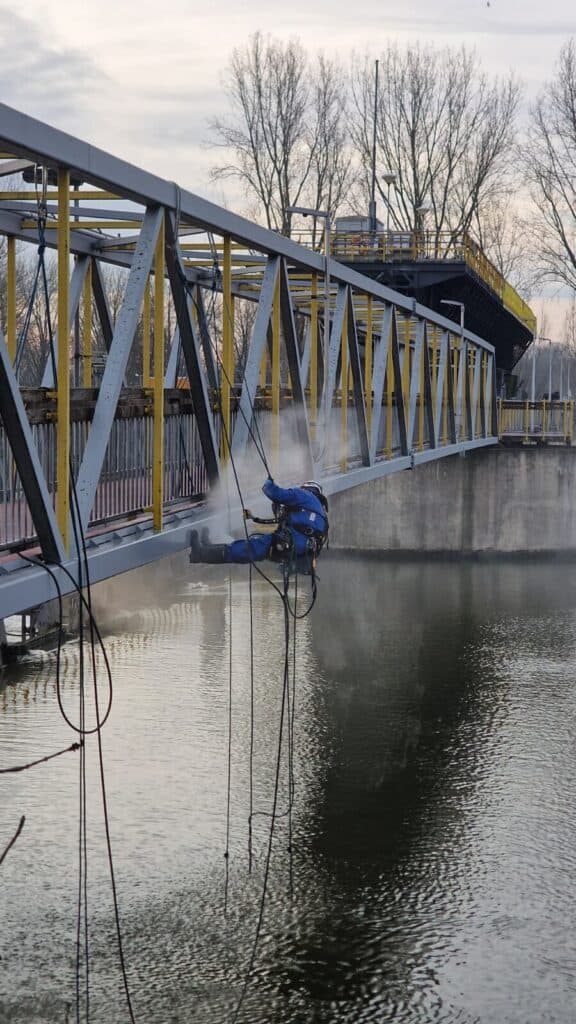
“We experience the collaboration with Sky People as a true partnership. They actively contribute ideas, are flexible, and focus with us on the safe and successful execution of the work. For example, we have collaborated on the bicycle bridge in Lelystad, where Zoet Services thoroughly cleaned the top side and the underside was executed in collaboration with Sky People. We definitely recommend Sky People due to their professional approach, commitment, and reliable effort.”
Mark Zoet
Sweet Services

Frequently asked questions
Rope access is used in utility construction for tasks involving heights and confined spaces. This includes inspection, maintenance, repair, and installation of various utilities such as power lines, pipelines, wind turbines, and communication infrastructure. Rope access provides a safe and efficient method for accessing difficult-to-reach areas without the need for extensive scaffolding or heavy machinery.
Rope access is used in the utilities construction sector for work on hard-to-reach parts of buildings. This includes facade maintenance, window cleaning, facade cleaning, assembly and disassembly, maintenance of installations, repair work, leak detection, blinds, insulation, and specialized work on the outer shell of a building.
The method is particularly suitable for office buildings, healthcare facilities, schools, hotels, parking garages, atriums, and other non-residential functions where scaffolding, aerial work platforms, or facade lifts are not practical. With Rope Access, work can often be carried out with less disruption to users, visitors, and the immediate surroundings.
Rope access is suitable for facade maintenance because it allows technicians to reach difficult-to-access areas of a building's exterior safely and efficiently. It minimizes the need for extensive scaffolding, which can be costly, time-consuming, and disruptive. Rope access also offers greater flexibility and mobility, enabling workers to scale, ascend, descend, and traverse facades with ease. This makes it an ideal solution for a wide range of tasks, including inspection, cleaning, repair, and installation on high-rise buildings and structures.
When it comes to facade maintenance, not all parts of a building are easily accessible with a cherry picker, scaffolding, or facade lift. Access can be difficult, especially with tall facades, atriums, courtyards, sloped roofs, overhangs, or buildings in busy urban environments.
Rope access allows technicians to be precisely positioned where maintenance is needed. This often enables tasks such as cleaning, inspection, assembly, sealing, coating repair, or minor repairs to be carried out efficiently, without the need for scaffolding to surround the entire building.
Can rope access be used for window cleaning?
Yes, Rope Access can be used for professional window cleaning in locations where standard methods are not suitable. Think of tall facades, hard-to-reach window sections, atriums, skylights, courtyards, or buildings where a cherry picker does not have a suitable setup location.
For property owners, facility managers, and building managers, Rope Access can be a practical solution for periodic window cleaning or one-off cleaning. The work can often be carried out with limited setup time and minimal disruption to daily operations.
Is rope access suitable for facade cleaning and specialized cleaning?
Yes, rope access is suitable for facade cleaning and specialized cleaning of hard-to-reach parts of buildings. This includes dirty facade panels, glass sections, steel structures, cladding, awnings, roof edges, atriums, and other components where regular access is limited.
Because technicians can position themselves using rope techniques, work can be focused on the areas that require cleaning. In many cases, this prevents the need for large scaffolding structures or lengthy closures around the building.
Can Rope Access be used for sunshades, insulation, and facade elements?
Yes, within utility construction, Rope Access can be used for the installation, dismantling, inspection, and repair of awnings, insulation, and facade elements. This includes placing or replacing parts on the facade, repairing fixings, or performing work on hard-to-reach facade sections.
For buildings where scaffolding, cranes, or aerial work platforms are difficult to deploy, Rope Access can be an efficient access method. For each project, the working method that is safe and practical for the location, the users, and the environment is assessed.
Can rope access help minimize disruption for building users?
Yes, Rope Access can help minimize disruption for building users in many cases. Because less equipment, less setup time, and less space around the building are often required, entrances, walkways, parking spaces, and workplaces often remain more accessible.
This is especially relevant for office buildings, schools, healthcare facilities, and other properties where daily operations must continue as much as possible. The work can typically be carried out in phases, coordinated with opening hours, user flows, and building security.
Is rope access suitable for work on atria and interior spaces?
Yes, rope access can also be applied in atriums, voids, halls, and other high indoor spaces. Consider maintenance of lighting, inspection of structures, cleaning of glass or facade cladding, assembly work, and specialized work at height.
In indoor spaces, the use of aerial work platforms or scaffolding is not always possible or desirable, for example, due to flooring, limited space, furnishings, or public traffic flow. Rope access can then offer a controlled and flexible access method, provided the situation can be set up safely.
Who does SkyPeople work for in the utility construction industry?
SkyPeople operates within the utility construction sector for various clients including property owners, homeowners' associations (VvEs), contractors, facility managers, building managers, and organizations with complex real estate. This includes offices, healthcare facilities, schools, public buildings, parking garages, and commercial properties.
SkyPeople thinks ahead about the best approach, performs a site survey, and, where necessary, draws up an action plan and Task Risk Analysis. This clarifies in advance which access method is suitable, which safety measures are required, and how the work can be carried out efficiently.
What is Rope Access?
Rope access is a specialized method for safely performing work at heights, depths, and in difficult-to-reach locations. Using rope systems, positioning techniques, and certified safety equipment, technicians can work safely in locations where traditional access methods are limited.
The technique is applied worldwide in the offshore, industrial, petrochemical, civil, and utility construction sectors for, among other things, maintenance, inspection, and execution work on installations, structures, and buildings.
Rope access offers an efficient alternative to scaffolding, aerial work platforms, and other conventional access methods, especially in locations where accessibility, safety, or operational impact are important considerations.
Due to the limited setup time, rapid deployability, and minimal environmental impact, rope access is increasingly being used worldwide in complex operational work environments.
Want to know more about the technique, safety, and applications of rope access? Then check out our pages: About Us – What is Rope Access?, Is rope access safe?.
What does 'IRATA certified' working mean?
IRATA stands for Industrial Rope Access Trade Association en is the highest safety standard worldwide for rope access work. Within offshore, industry, petrochemical, and infrastructure sectors, this certification is used to ensure safe execution, fixed work methods, and high training standards.
To be allowed to work with rope access, technicians must successfully complete extensive training, practical exams, and rescue exercises. In addition, IRATA technicians always work according to international guidelines, fixed safety procedures, and controlled work methods.
Within IRATA, there are three certification levels:
- Level 1
A Level 1 technician performs rope access work under the supervision of an experienced Level 3 supervisor after obtaining their certification. This is the entry-level position within rope access. - Level 2 — minimum of 1,000 logged work hours
After a minimum of 1,000 hours of practical experience, a technician can become certified to Level 2. At this level, technicians perform more complex tasks and receive additional training in areas such as rescue procedures and work positioning. - Level 3 — minimum of 1,000 additional work hours as Level 2
A Level 3 supervisor is responsible for the safe execution of rope access work on site. After obtaining this certification, the supervisor is authorized to assess risks, control work methods, perform safety checks, and provide continuous supervision during project execution.
All IRATA technicians are re-examined and re-certified every three years. During this re-certification, practical skills, rescue procedures, safety knowledge, and work methods are reassessed according to international IRATA guidelines.
This makes IRATA one of the strictest and most controlled systems worldwide for working safely at height and in hard-to-reach locations.
