Complex work environments



Our
services

Maintenance and specialized works on civil engineering structures
Civil engineering requires periodic maintenance, inspection, and repair work, while the availability of infrastructure remains paramount. Our specialists provide support for conservation work, cleaning, inspections, non-destructive testing, assembly work, rigging & lifting, and repair work on steel and concrete structures, among other things.
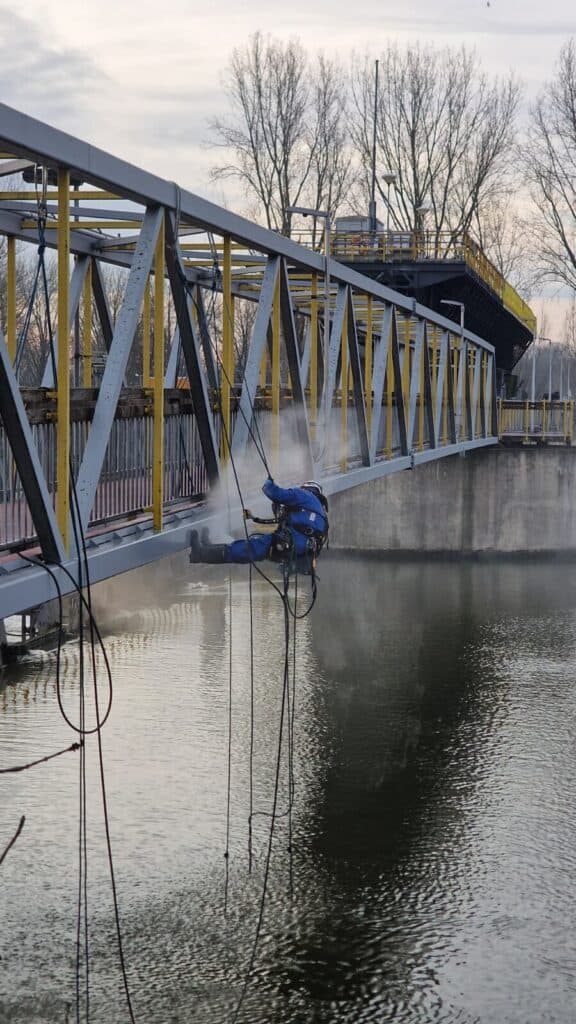
Work is carried out at locations such as bascule pits, bridges, hydraulic structures, high-rise buildings, infrastructure, telecom installations and masts, as well as hard-to-reach parts of infrastructural objects above water or at height.
Thanks to rope access, work can be carried out in a targeted manner without extensive scaffolding or prolonged closures of infrastructure or shipping.

From inspection and preservation to technical maintenance
SkyPeople supports diverse disciplines within civil and infrastructure. From preservation and cleaning work to inspection, NDO, welding, E&I work, and maintenance of existing structures and installations.
Our specialists are familiar with work within operational environments where safety, planning, accessibility, and collaboration between disciplines play an important role. This allows work to be efficiently combined within maintenance, renovation, and project-based trajectories.
Where necessary, we combine specialist access with lifting and positioning work, temporary facilities, and support during complex maintenance projects.
Prior to execution, we determine the work method, schedule, and safety documentation for a controlled and efficient project implementation.

Professional support from preparation to execution
SkyPeople supports property owners, homeowners' associations, contractors, and facility managers with maintenance, inspection, and installation work at heights. We advise on the most efficient access method and tailor our approach to the building's schedule, accessibility, and usage.
Every project begins with an on-site work inspection. Based on this, we create an action plan and a Task Risk Analysis, so that work can be carried out safely, efficiently, and according to schedule.
From preparation to delivery, SkyPeople ensures structured coordination and execution of the entire process.
Projects in
hard-to-reach places




What our
clients say
“We experience the collaboration with Sky People as a true partnership. They actively contribute ideas, are flexible, and focus with us on the safe and successful execution of the work. For example, we have collaborated on the bicycle bridge in Lelystad, where Zoet Services thoroughly cleaned the top side and the underside was executed in collaboration with Sky People. We definitely recommend Sky People due to their professional approach, commitment, and reliable effort.”
Mark Zoet
Sweet Services


“Skypeople has addressed some of the accessibility challenges on the Erasmus Bridge project for Van der Ende by thinking solution-oriented, where traditional scaffolding was not an option. With excellent collaboration, the highest parts of the Pylon and the ballast block in the bridge cellar have been safely and expertly preserved, and the cables cleaned. Skypeople has thus made a huge contribution to this magnificent project.”
Michael
Lars Sigmond

Frequently asked questions
For what is Rope Access used in civil engineering and infrastructure?
Rope access is used in civil engineering and infrastructure for work on hard-to-reach infrastructural objects. This includes bridges, locks, viaducts, hydraulic engineering structures, stations, stadiums, masts, telecommunication installations, and steel or concrete structures.
The method is suitable for maintenance, inspection, NDO (non-destructive testing), preservation, cleaning, assembly, disassembly, welding, rigging & lifting, and repair work. Rope access can be an efficient access method, especially for objects above water, along roads, under bridge decks, or at height, when scaffolding, aerial platforms, or cranes have limited usability.
Why is rope access suitable for bridges and viaducts?
Bridges and viaducts often have components that are difficult to access from the road, water, or existing walkways. With rope access, technicians can position themselves precisely at, for example, the undersides of bridge decks, steel structures, bearings, edges, cables, pipes, or anchor points.
This means that extensive scaffolding or long-term road closures are not always necessary. This makes Rope Access suitable for inspection, maintenance, preservation, installation, and repair work on bridges and overpasses where accessibility and traffic flow are important.
Can rope access help to minimize traffic disruptions?
Yes, in many situations, rope access can help to limit traffic disruption. Because less equipment, setup time, and workspace are often needed compared to traditional access methods, work can be carried out more efficiently.
For bridges, viaducts, stations, and other infrastructural objects, this can mean that lanes, bicycle paths, footpaths, or surrounding zones need to be closed off for a shorter period or to a lesser extent. For each project, it is assessed which work method is safe, practical, and efficient within the environment.
Is rope access suitable for work over water?
Yes, Rope Access can be used for work on objects above or alongside water, such as bridges, locks, quays, and hydraulic structures. This includes inspection, preservation, cleaning, assembly, disassembly, and technical maintenance.
For work over water, preparations require extra attention to safety, rescue procedures, weather conditions, accessibility, and coordination with the surroundings. Rope Access can be a practical solution when access from scaffolding, pontoons, aerial work platforms, or vessels is limited or less efficient.
Can Rope Access be used for locks and hydraulic engineering structures?
Yes, Rope Access is suitable for work on locks and hydraulic structures. These objects often have complex shapes, limited access zones, and parts that are difficult to reach from fixed platforms or work floors.
Rope access can be applied for inspection, maintenance, preservation, cleaning, repair work, and assembly or disassembly work. This involves a prior assessment of accessibility, safety, work permits, water levels, scheduling, and any impact on shipping or use of the installation.
What types of work can be performed on steel and concrete structures?
Rope access can be used for a variety of tasks on steel and concrete structures. This includes visual inspections, NDO, concrete inspection, conservation, coating repair, cleaning, welding, assembly, disassembly, and technical maintenance.
In civil engineering and infrastructure, projects often involve bridges, overpasses, masts, stadiums, stations, pipe racks, quay walls, and other structures where parts are difficult to access. By combining rope access with technical specialists, work can be carried out directly at the required location, without the constant need for heavy temporary facilities.
Is rope access suitable for inspection and NDO of infrastructure objects?
Yes, Rope Access is well-suited for inspection and NDT of infrastructure objects. Technicians can reach hard-to-access parts of bridges, viaducts, locks, steel structures, masts, or hydraulic engineering objects without always needing scaffolding or aerial work platforms.
This is particularly valuable for periodic inspections, damage surveys, maintenance preparation, and renovation projects. By conducting inspections using Rope Access, the condition of components can be specifically assessed while often limiting the impact on traffic, the environment, or usage.
Can SkyPeople brainstorm about the work method and preparation?
Yes, SkyPeople collaborates on the right working methods, planning, and preparation of civil and infrastructural projects. For every project, factors such as accessibility, safety, required disciplines, traffic measures, potential closures, and environmental impact are considered.
Based on this, it can be determined whether rope access is the most suitable access method. Where necessary, SkyPeople also provides support in developing an action plan, a Task Risk Analysis, and further coordination towards execution.
What is Rope Access?
Rope access is a specialized method for safely performing work at heights, depths, and in difficult-to-reach locations. Using rope systems, positioning techniques, and certified safety equipment, technicians can work safely in locations where traditional access methods are limited.
The technique is applied worldwide in the offshore, industrial, petrochemical, civil, and utility construction sectors for, among other things, maintenance, inspection, and execution work on installations, structures, and buildings.
Rope access offers an efficient alternative to scaffolding, aerial work platforms, and other conventional access methods, especially in locations where accessibility, safety, or operational impact are important considerations.
Due to the limited setup time, rapid deployability, and minimal environmental impact, rope access is increasingly being used worldwide in complex operational work environments.
Want to know more about the technique, safety, and applications of rope access? Then check out our pages: About Us – What is Rope Access?, Is rope access safe?.
What does 'IRATA certified' working mean?
IRATA stands for Industrial Rope Access Trade Association en is the highest safety standard worldwide for rope access work. Within offshore, industry, petrochemical, and infrastructure sectors, this certification is used to ensure safe execution, fixed work methods, and high training standards.
To be allowed to work with rope access, technicians must successfully complete extensive training, practical exams, and rescue exercises. In addition, IRATA technicians always work according to international guidelines, fixed safety procedures, and controlled work methods.
Within IRATA, there are three certification levels:
- Level 1
A Level 1 technician performs rope access work under the supervision of an experienced Level 3 supervisor after obtaining their certification. This is the entry-level position within rope access. - Level 2 — minimum of 1,000 logged work hours
After a minimum of 1,000 hours of practical experience, a technician can become certified to Level 2. At this level, technicians perform more complex tasks and receive additional training in areas such as rescue procedures and work positioning. - Level 3 — minimum of 1,000 additional work hours as Level 2
A Level 3 supervisor is responsible for the safe execution of rope access work on site. After obtaining this certification, the supervisor is authorized to assess risks, control work methods, perform safety checks, and provide continuous supervision during project execution.
All IRATA technicians are re-examined and re-certified every three years. During this re-certification, practical skills, rescue procedures, safety knowledge, and work methods are reassessed according to international IRATA guidelines.
This makes IRATA one of the strictest and most controlled systems worldwide for working safely at height and in hard-to-reach locations.
