Complex work environments



Electrical work within operational installations
E&I activities often take place within operational facilities where accessibility, limited space, and continuity play a significant role. Our specialists support work on electrical installations, cable trays, tank installations, and new construction projects within industrial facilities, utility buildings, and civil structures, both horizontally and vertically in hard-to-reach locations.
Our specialists provide support for, among other things, pulling and connecting power and instrumentation cables, installing junction boxes, tracing, cable supports, sensors, and measurement and control technology. In addition, we perform revision, maintenance, and expansion work on existing installations and systems.
By using rope access as an access method, work can be carried out in a targeted manner without extensive scaffolding or additional access systems.
Maintenance, overhaul, and installation work
SkyPeople supports E&I activities during shutdowns, turnarounds, maintenance stops, and project-based installation work within the offshore, industrial, petrochemical, and utility construction sectors. Our specialists are familiar with working within operational facilities where planning, coordination, and controlled execution are essential.
Work will be carried out in accordance with applicable standards, specifications, and safety procedures that are compatible with the project's environment and application.
Prior to execution, we map out accessibility, safety risks, and operational conditions. Based on this, we determine the working method, schedule, and safety documentation for a controlled project execution.
Experience
within complex work environments
SkyPeople supports projects in offshore, industry, petrochemicals, civil engineering, and utility construction in locations where accessibility, safety, and continuity are paramount. Our specialists are familiar with working in complex environments.
Prior to execution, we determine the work method, schedule, and safety documentation for a controlled and efficient project execution.


Projects in
hard-to-reach places


What our
clients say

“It was very pleasant to work with these gentlemen; they are professional and thoughtful. And not to forget, you can consult with them very well about the approach to the work. I am very satisfied with the result of the work. I greatly appreciate the effort and commitment of both, and I look forward to any future collaboration with confidence. Should an opportunity arise again to work together, I will certainly be positive about it.”
Fulco Hokke
Tasty dungeon
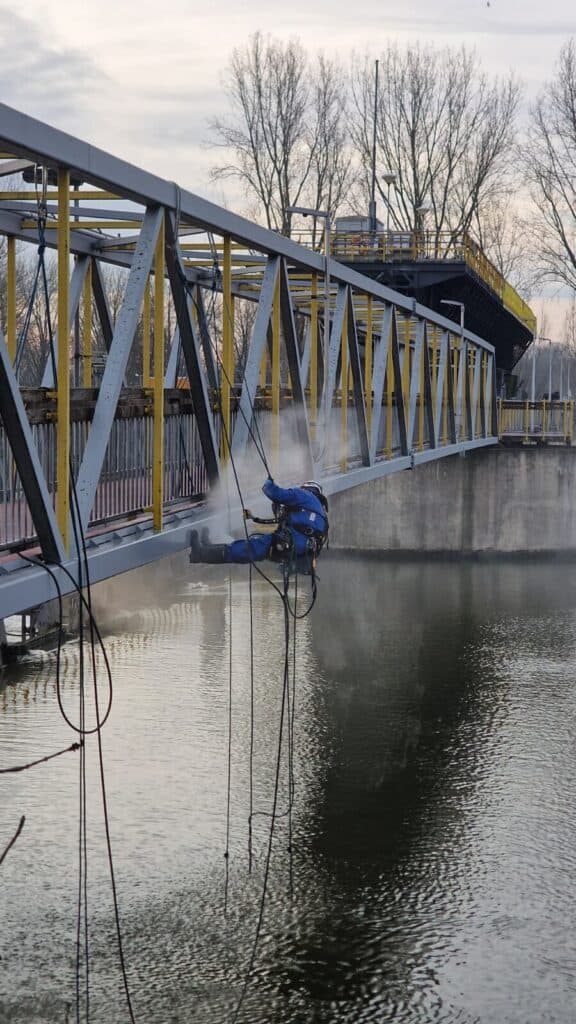
“We experience the collaboration with Sky People as a true partnership. They actively contribute ideas, are flexible, and focus with us on the safe and successful execution of the work. For example, we have collaborated on the bicycle bridge in Lelystad, where Zoet Services thoroughly cleaned the top side and the underside was executed in collaboration with Sky People. We definitely recommend Sky People due to their professional approach, commitment, and reliable effort.”
Mark Zoet
Sweet Services

Frequently asked questions
What is included in E&I work with rope access?
E&I work with Rope Access involves electrical and instrumentation tasks in locations that are difficult to reach with scaffolding, aerial work platforms, or fixed access systems. This includes work on cable trays, cable supports, junction boxes, tracing, sensors, measurement and control technology, lighting, power cables, and instrumentation cables.
SkyPeople supports these activities within offshore, industry, petrochemicals, civil & infrastructure, and utility construction. Rope Access is used as an access method, enabling technicians to work safely and in a controlled manner at height, vertically along structures, or within complex installations with limited space.
Rope access is suitable for electrical work when traditional access methods like scaffolding or cherry pickers are impractical, too costly, or unsafe. This includes situations like:* **Working at height in confined spaces:** Where scaffolding would obstruct access or limit maneuverability. * **Temporary or short-duration tasks:** When the cost and time to erect scaffolding outweigh the benefits. * **Difficult or complex structures:** Such as bridges, tall buildings, wind turbines, or industrial plants where anchoring points are readily available. * **Emergency repairs:** Where quick access is critical and setting up elaborate scaffolding would delay the fix. * **Maintaining operations in sensitive areas:** Where minimizing disruption is important, and scaffolding might interfere with ongoing work or processes. * **Inspections and diagnostics:** Where visual access or minor electrical work is needed at height without the need for extensive work platforms.
Rope access is suitable for electrical work when the worksite is difficult to reach or when traditional access methods require too much time, space, or equipment. This is often the case in industrial installations, tank environments, pipe racks, steel structures, offshore assets, high facades, masts, and civil structures.
The method is particularly interesting when work needs to be carried out with minimal impact on the environment or operations. Consider the installation, replacement, inspection, or expansion of electrical components in locations where scaffolding or aerial work platforms are practically difficult to deploy.
Can SkyPeople pull and connect cables in hard-to-reach locations?
Yes, SkyPeople can assist with pulling and connecting power cables and instrumentation cables in hard-to-reach locations. This includes cable running along steel structures, piping, tank installations, industrial facilities, utility buildings, or civil objects.
With Rope Access, technicians can position themselves in places where regular access is limited. This allows cable work to be carried out in a targeted manner without the constant need for extensive scaffolding. Prior consideration is given to accessibility, cable routes, safety risks, work permits, and the technical specifications of the project.
Can Rope Access be used for junction boxes, tracing, and sensors?
Yes, Rope Access can be used for work on junction boxes, tracing, sensors, and instrumentation. This is particularly relevant within industrial and petrochemical plants, offshore environments, and other complex locations where components are mounted at height or in hard-to-reach places.
The work can include assembly, connection, inspection, replacement, overhaul, or expansion. By combining Rope Access with E&I specialists, the worksite can be safely accessed and the technical execution can take place without always needing separate access systems.
Is rope access suitable for E&I work during shutdowns and turnarounds?
Yes, Rope Access is suitable for E&I work during shutdowns, turnarounds, and maintenance stops. During these periods, planning is often tight, and multiple disciplines need to be able to work safely alongside each other.
With Rope Access, E&I specialists can quickly access hard-to-reach parts of a facility. This can help to efficiently integrate tasks such as cabling, tracing, component assembly, overhaul, inspection, and extensions into the overall maintenance program. Accessibility, planning, safety documentation, and coordination with other parties are mapped out in advance.
Can E&I work be performed within operational facilities?
Yes, E&I activities can be carried out within operational installations, provided the activities can be safely prepared and coordinated with the applicable procedures. Within industry, petrochemicals, and offshore, work permits, risk analyses, production status, ATEX zones, lock-out/tag-out procedures, and coordination with the client play an important role.
Rope access can help carry out targeted work in hard-to-reach places with minimal operational impact. For each project, the necessary work method, schedule, and safety measures for controlled execution are assessed.
Can SkyPeople E&I combine work with maintenance or inspection?
Yes, E&I work can often be combined with maintenance, inspection, or other technical tasks. Examples include checking cabling, replacing components, performing overhaul work, or identifying defects during a maintenance campaign.
Combinations with NDT/inspection, assembly, disassembly, rigging & lifting, or general technical maintenance are also possible. By combining access and technical execution, a difficult-to-reach workspace does not need to be accessed repeatedly. This can simplify planning and limit lead times.
For which sectors does SkyPeople E&I carry out activities?
SkyPeople performs E&I (Electrical & Instrumentation) services within the offshore, industrial, petrochemical, civil & infrastructure, and utility construction sectors. In practice, this includes, for example, industrial installations, tank installations, new construction projects, utility buildings, civil structures, offshore assets, and other complex work environments.
What these sectors have in common is that accessibility, safety, and continuity are important. Rope access is used when electrical or instrumentation work needs to be performed at locations where standard access methods are limited.
How does SkyPeople prepare for E&I work?
Prior to E&I work, SkyPeople assesses accessibility, safety risks, and operational conditions. This includes examining the technical scope, location, work permits, required disciplines, schedule, safety documentation, and coordination with other parties on-site.
Based on this, it is determined whether rope access is the appropriate access method and how the work can be carried out safely and efficiently. This is particularly important for operational facilities, shutdowns, turnarounds, and projects involving electrical work in complex or confined work environments.
