
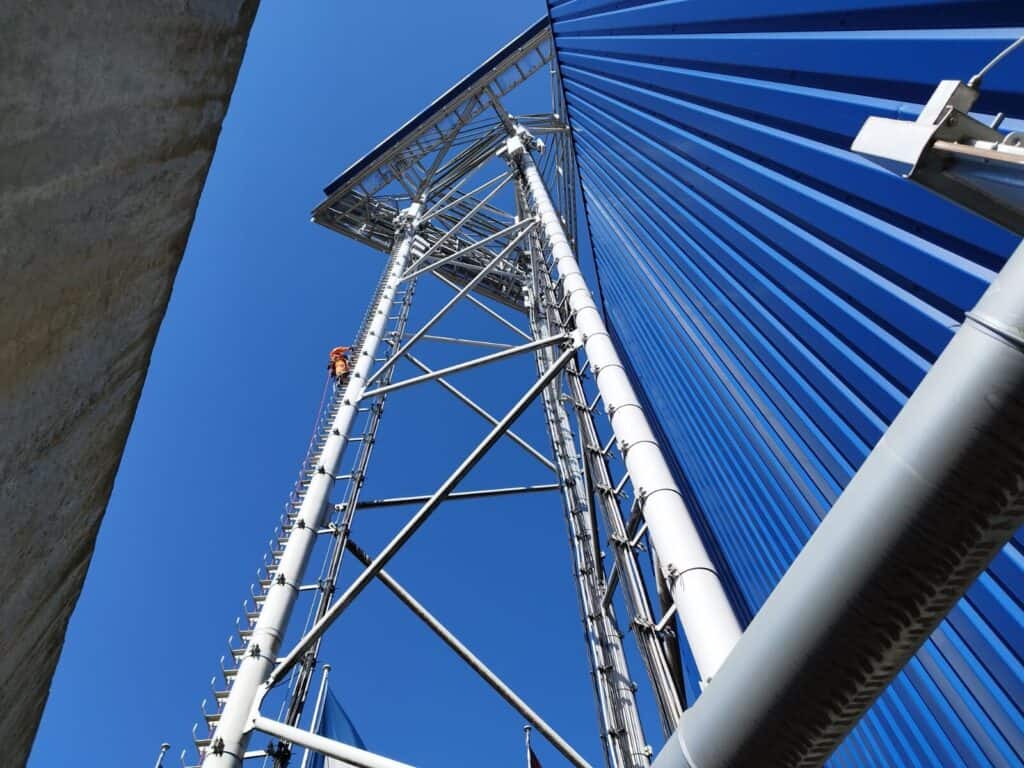
Rope Access vs. Aerial Work Platform or Scaffolding: What's the Best Choice?
You're facing a logistical challenge: urgent maintenance, inspection, or repair at height needs to be done. What's your first reflex? It's highly likely you'll immediately request quotes for renting a cherry picker or erecting a traditional scaffold.
But is that the most efficient route?
In practice, we see that traditional methods often lead to unnecessary delays. Especially in busy city centers or complex industrial facilities, you quickly run into limitations. Permits take a long time, the street needs to be closed off, and costs add up.
Rope access (industrial abseiling) offers a safe, fast, and extremely cost-efficient alternative for this.
In short: When do you choose rope access?
You opt for rope access instead of scaffolding or a cherry picker when:
Accessibility is a problem: Ideal for confined spaces, above water, or at extreme heights where heavy machinery cannot reach.
Speed and flexibility are crucial: Rope access systems are often operational within an hour and can also be dismantled just as quickly.
You want to eliminate hidden costs: You directly save on expensive road closures, object permits, and the long setup and dismantling time of heavy equipment.
The hidden pitfalls of traditional equipment
When calculating budgets for working at height, many project managers focus purely on the bare rental price of scaffolding or a cherry picker. That is an expensive miscalculation.
The real cost drivers are in the prerequisites and downtime.
A scaffolding crew often spends days on assembly and disassembly. During that time, your project comes to a standstill, you may block a public road (incurring administrative fees from the municipality), and local residents experience nuisance. With a cherry picker, you are constrained by a large physical footprint on the ground, which can block internal transport routes on your own property.
Why Rope Access Is Often the Smarter Choice
Rope access turns the logistics of working at height on its head. Instead of building up from the ground, IRATA-certified technicians work from top to bottom using certified rope systems.
This provides three firm guarantees:
Minimal Footprint (Zero Footprint) The ground environment remains completely clear. No road closures are necessary and the daily business operations or traffic experience zero disruption.
Rapid mobilization A team of SkyPeople arrives, installs the rope techniques on the anchor points, and is at work within an hour.
Prompt action: For short jobs (such as a visual facade inspection, NDT inspection, or small assembly work), industrial abseiling is unbeatable in efficiency.
The Access Methods Matrix
Which method best suits your project? Compare the main criteria in the overview below:
| Project Criterium | Rope Access (SkyPeople) | Aerial work platform | Scaffolding |
| Build time | Less than 1 hour (Very fast) | Direct (if transport is arranged) | Days to weeks (Slow) |
| Need floor space | No (Path/sidewalk remains clear) | Much (Blocks the lane) | Very much (Permanent block) |
| Costs (short job) | Low (Effective hours only) | Average to high | Very High (Startup Costs) |
| Permits | Seldom or never | Often (due to road closure) | Always (Object Permit) |
| Best usable at | Inspection, cleaning, assembly | Lifting heavy objects | Long-term, heavy renovation |
When is an aerial work platform or scaffold the right choice?
As experts in working at height, we always provide honest advice, even if rope access is not the best solution for your specific situation.
Choose scaffolding when:
You have a long-term project (for example, intensive facade restoration lasting months).
Constant work must be done with heavy building materials (such as pallets of bricks).
Multiple disciplines (painters, tilers, plumbers) have to work alongside each other simultaneously.
Choose a mobile elevated work platform when:
There is a flat, sturdy surface directly next to the object.
You need to lift and mount very heavy objects on the facade, and the object is easily accessible by vehicle.
The rule of thumb is simple: the shorter the job and the more complex the accessibility, the stronger the business case for rope access becomes.
How safe is industrial abseiling?
The biggest misconception in the construction industry is that hanging from a rope is unsafe. Statistics show the opposite. Rope access is, thanks to strict protocols, statistically safer than traditional scaffolding. The Dutch Labour Inspectorate therefore recognizes industrial rope access as a fully qualified and safe access method within the legislation for working at height.
At SkyPeople, we have a zero-tolerance policy for unsafe behavior:
IRATA Certification All of our technicians are trained to the strict, global IRATA standards.
100% Redundancy: Each technician is suspended from two independent lines (a working line and a backup line).
Self-reliance Our teams are trained in complex rescue techniques. They can evacuate a colleague in distress within minutes, without the fire department needing to be involved.
Mandatory Risk Inventory & Evaluation No project starts without a comprehensive, custom-made Risk Inventory and Evaluation.
Make the smart choice for your project
Choosing the right access method determines the success, speed, and ultimate budget of your project. Are you struggling with logistics, lacking space for heavy equipment, or simply unwilling to pay for unnecessary overhead? Then rope access is the key to success.
Ready to work more efficiently at heights?
Curious if rope access is the best business case for your next challenge? Contact the experts at SkyPeople today for a no-obligation consultation. We'll collaborate with you to deliver a safe, fast, and cost-effective custom solution.
